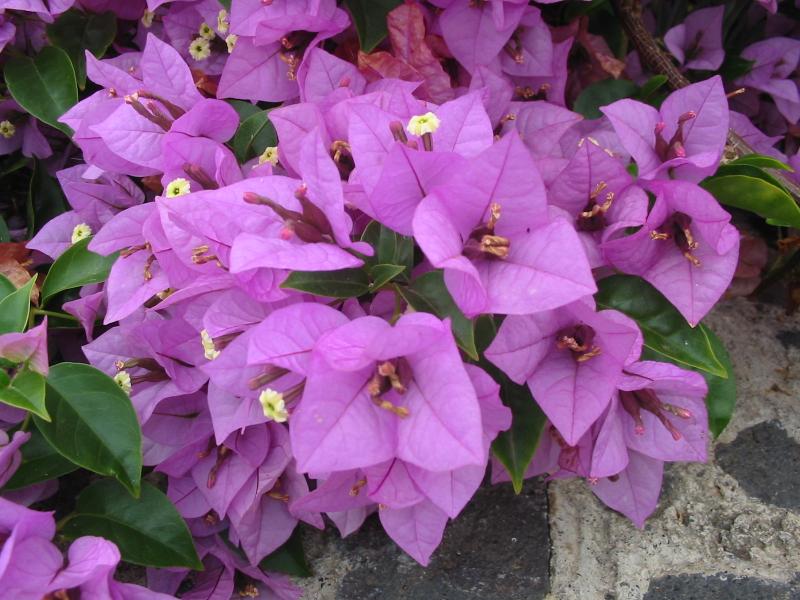
Here are some flowers I encountered in a small park in Puerto de la Cruz on my evening stroll. I thought this was a wild rose, but a reader has helped me identify this as an Ivy-leaf Geranium.
Purple Bougainvillea.
Red Bougainvillea with banana plant in background.
Yellow Hibiscus.
Red Hibiscus.
Tall cactus outside holiday home.
I got up early, had a breakfast of an ensaïmada (a Mallorcan pastry) and orange juice from one of the many commuter cafes in Barcelona, surfed a bit at an Internet cafe and returned to the residencia to pack up and head out to the airport. The Air Europa flight was full of Spaniards.
The Canary Islands comprise 7 major islands. I would visit 5 of them. I would start from the largest, Tenerife, visit Gomera on a day trip, skip the 2 westernmost islands of La Palma and El Hierro, and progress eastwards. I would return to Barcelona from Lanzarote, the easternmost island.
The Canaries are a political oddity. They are closest to Africa but politically in Europe. Although they were inhabited before Europeans arrived, Spain took control of the islands in the 15th century.
The islands enjoy a sub-tropical climate, it's never too hot or too cold there and sunshine is abundant. As you can imagine this makes them a desirable holiday destination. In fact, one problem for the independent traveller is that most visitors come on package tours and stay in apartments so there are few backpacker establishments.
The islands are volcanic in origin and there is still activity on Lanzarote. The rain bearing winds diminish going east so the westernmost islands are the lushest.
The name is thought to come from the Latin for dog. It may have referred to a species of seal which the Romans saw when they discovered the islands. The eponymous native bird is actually named after the islands.
On arrival I could catch a bus to either the capital of Tenerife, Santa Cruz, near the north-east tip of the wedge-shaped island, or Puerto de la Cruz, on the mid-northern coast of the island. I decided on the latter, as visitor destinations are away from the capital. On the last part of the journey, the road passed banana plantations on slopes descending to ocean. Despite the tourism, the Canaries still supply many of Spain's bananas. I found a room at the Hotel Alfomar. It was not crowded because it was spring. The two visitor peaks are during the European winter for obvious reasons, but also during summer, when the Canaries are cooler than mainland Spain.
During my evening stroll I found a small park with many of the colourful flowers that flourish in the mild climate. I'll post those in the next blog entry. As dusk fell a pleasant coastal breeze swept through the old town.
The hotel in the picture lit up the waves crashing against the dramatic rocky shoreline.
One of the many snack stalls in the old city.
A slightly shaken picture of the central plaza.
I noticed, listening with my pocket FM radio, that there was a station broadcasting in German, and it even gave traffic updates about German cities. My deduction was that there was a radio relay service to cater for the German visitors and long term residents.
The city was quiet on a Sunday morning. Along the way to Estació de Nord I saw many a Chinese import/export business. Looked like the Chinese were setting up here too.
The train to Blanes hugged the Costa Brava and passed many a unremarkable suburban beach. At Blanes I switched to a bus. Here the coastline becomes rocky and indented and the train line parts company with it. I changed buses at Lloret de Mar, which was crawling with tourists.
Tossa de Mar was in a beautiful bay with resort hotels. What made the trip worthwhile was the Vila Vella with the ruins of a castle overlooking the bay, from which one can see up and down the coast. Otherwise Tossa would just be another sea and sand resort with oily bodies.
I took a lunch at a local restaurant but found it oversalted. Restaurants were expensive in Catalunya. Also I was intimidated by the fine dress the Catalans wore while eating out. That's why I usually ended up at buffet restaurants or having street food. I wondered if they spent more on dining out because they didn't have much chance to pay towards a home, prices being what they were
A group of school children boarded the train on the return journey. I guessed that they were on an organised weekend excursion. Barcelona seemed well run; public amenities worked, the trains ran on time, etc.
Back at Estació de Nord, I learnt that there were two direct buses a day to Cadaques. So I booked by phone a room there for when I got back from the Canary Islands. I got a room at a Port Lligat hotel which was better than Cadaques because it was where Dalí had lived.
I missed having company. In a city like Barcelona, there were few chances to meet fellow travellers if one stayed in pensions or hotels. In Cuba there was the camaraderie forged from the hardship of travelling around.
I heard the residencia owner Thomas playing his guitar in the evening. He spoke very good English with only a trace of accent. If you want to know how the people of Spain speak, listen to an Almodovar film; they tend to pronounce the s like sh. Thomas played gigs around town. Apparently performing was his true passion and running the residencia made ends meet.
When I got back to Barcelona, it was around 2000 but there was a lively street parade on the Passeig de Gràcia, one of Barcelona's major avenues.
Some of the participants were protestors who thought that the Forum was a waste of money and that some of the sponsors were war supporters.
There was loud drumming and street dancing.
This was a Brazilian themed float which was a giant boom box with dancers on top.
As dusk fell, the parade thinned away. This was the beautiful fountain at the intersection with Gran Via, looking towards the Cine Comedia.
The view at the Plaça de Catalunya, looking towards the Barcelona branch of El Cortés Ingles, Spain's largest department store chain.
I had a simple dinner of a felafel from Maoz, a chain of vegetarian fast food restaurants started by an Israeli couple in Amsterdam. That went down well with the ½ kg of strawberries that I bought in Sitges. And so to bed, after finishing Thinks.
I was a bit wary after Cuba, but I found it refreshing to be not an object of curiosity in Barcelona. Also the Catalans are polite and did not stare or signal in any way that I was anything out of the ordinary. Of all the peoples living around the Mediterranean, I admire the Catalans the most. While the centre of Spain was mired in backwardness at the start of the 20th century, Catalunya was industrious and progressive. Today it is still a powerhouse within Spain. The Catalans have preserved their regional identity well inspite of the repression of the Franco era.
Of course, on Las Ramblas, one cannot help being noted as a tourist by the touts and pickpockets but as long as you ignore them, and watch your pocket, everything will be fine.
I was curious to see what Els Encants Vells (The Old Charms), the flea market, was like. It is close to the Plaça de les Glòries Catalanes. It looked the same as 11 years ago. Even the xurrreria (churro stall) was in the same spot, so I indulged in one. Of course, the used bric-a-brac on offer had been updated with the times.
My breakfast of cafe con leche and a slice of spinach tortilla had been a bit inadequate, so I made up for that by having a large lunch at FresCo, which is a chain of all you can eat buffet restaurants serving mostly vegetarian food. It was probably healthier for me too.
This is Plaça Toros de Monumental, a bullfight ring, as you can tell from the name, but as at the time of writing, this sport having been banned in Catalunya, has been repurposed for concerts and circuses. The pictures of La Sagrada Familia were actually taken this day, but I posted them yesterday to spread out the photos. It was in construction; in fact, it always is. Since Gaudi's plans were extensive, the work will not be finished until some time between 2017 and 2026, depending on which projection you believe.
Then it was off by train to Sitges, a fashionable beach resort a ½ hour by train to the southwest. I could tell that it received many foreign visitors from the many languages on advertisements. I got there rather late, around 1700, but since the days were long, it didn't matter, and it was also cooler, the perfect temperature for me.
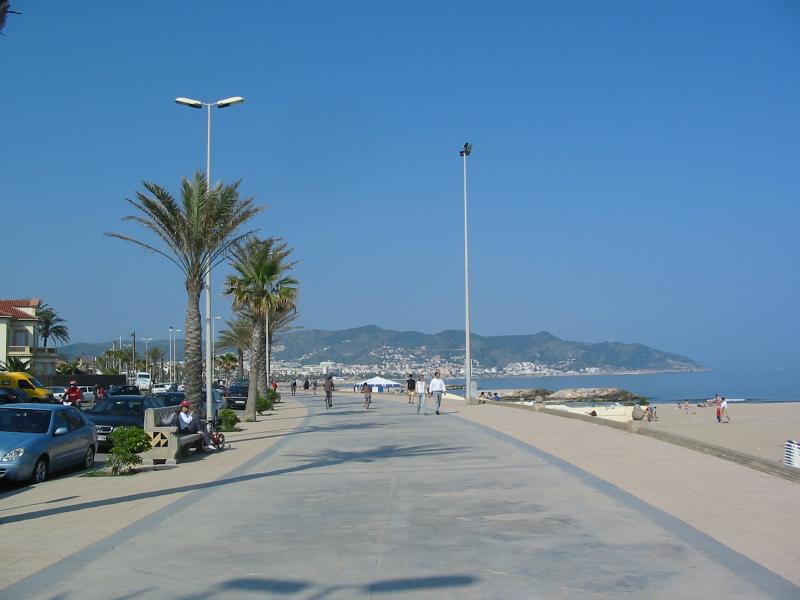
There is a long promenade with clear views in all directions. Azure skies, golden beaches, this is the Mediterranean of many dreams.
Most of the people taking their ease on this Saturday appeared to be locals. The busy season had not started. Apparently it gets very packed in high summer.
I was pleased to see that the hotel at the end of the promenade was called Terramar, a welcome change from the clichéd Miramar.
Children were also catered for.
The Església de Sant Bartomeu i Santa Tecla which anchors the northern end of the beach.
And peeking just around the corner from that.
An atmospheric street in the town. I'm sure that there was a gelato involved at some point. These things happen.
The rest of the evening in Barcelona is in the next post due to the amount of pictures.
I didn't mind that my residencia did not serve breakfast because as the owner explained, and I was fully aware, I could get a very good breakfast at La Boqueria, the produce market near Las Ramblas.
It was a joy to see such an abundance of colour and smells after the paucity of Cuba that I shall devote this entire post to pictures from the market. Enjoy them.
The first two pictures are of a fruit stall, and a cheese and smallgoods stall respectively. This one is a food kiosk.
Shellfish stall. The hanging bags contain clams.
Fishmonger.
The only outdoor shot I took of the market.
Preserved olives and other condiments.
This is where I had breakfast, sitting at the counter. Notice the ¡no a la guerra! poster.
Vegetable stall.
The early sun woke me but I stayed in bed until 0730 to get more rest. I retraced yesterday's route to the airport. There was plenty of time to make my Thalys reservation at the international counter for when I returned from the Canaries.
This leg was a "freebie"; my ticket was a return to Barcelona with a stopover in Amsterdam. It was KLM's way of attracting customers—throw in a roundtrip from Amsterdam to another European city. So strictly speaking I hadn't yet reached my "ultimate" destination in Europe after having been on the road for 6 weeks.
The electronic check-in was slick. I gawked at the goods in the duty-free stores, then had a pre-flight lunch at Sbarro of a pizza slice with lots of garlic and oregano. This section of the airport was not passport controlled because it was an intra-Schengen flight. There were insufficient seats in the departure lounge. The plane was full of Dutch tourists. Did they get a cheap fare for this leg? Did they know that there was a Forum going on in Barcelona and that accommodation was in short supply? But accommodation is often scarce in Barcelona; it's a popular destination.
My first glimpse of Barcelona after 11 years of absence was not encouraging. The outdoors was dusty and the ugly apartments by the train line were still there. But it was better in the centre. The city had become even more glitzy. The restaurants were tempting. While I had been away, Spain had adopted the Euro so I didn't have to think in hundreds of pesetas for a meal. But what I ate wasn't worth 21€, but the ice cream afterwards was good.
My residencia room was small but adequate. I read myself to sleep with 3 chapters from David Lodge's Thinks, a paperback I found in the reception's collection.