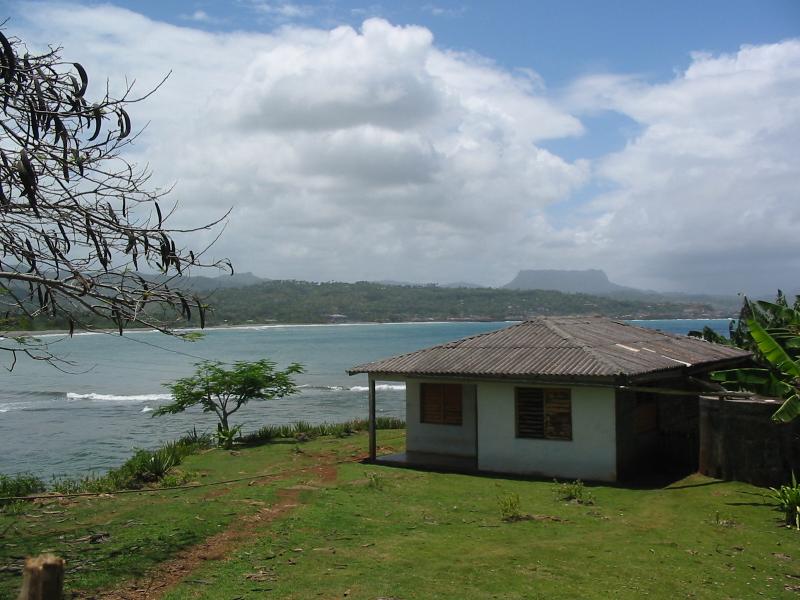
I got up very early for the trip to Guadalavaca. The landlady had prepared breakfast. She said: I woke up every hour when the grandfather clock went bong!, checked my watch and went back to sleep for another hour, until it was the right time. Oh no! I felt guilty that she had gone to all that trouble. I should have given her my alarm clock, but it was the only one I had, and battery powered, maybe not a good thing in Cuba.
The streets were cool and quiet at 0600 as I walked to L's casa. Her landlady explained the modus operandi: When the workers' bus for Guardalavaca arrives you get on and give the driver the fare. The driver let me on but he wouldn't take L. I pleaded with the driver but he was firm. L said to me: You go then. I said to the driver: She's with me, we either go together or not. The driver wouldn't relent, so that was that. L looked upset; discrimination hurts. I don't know why I passed muster but she didn't. Perhaps I didn't look as out of place amongst the workers as an Aussie girl might.
We went back the casa and told our tale. The landlady said to go to the bus station and try to get transport to Rafael Freyes and from there change for Guardalavaca. The first part of the journey in a open camion (lorry) was cool with the fresh air. At Rafael Freyes, a road junction and transport interchange, the system broke down. There was a long queue for Guardalavaca. After ½ hour a bus came. It was crammed like crazy but friendly locals pushed us onto the bus. (The guide had said that this part of Cuba was the most friendly for this sort of adventure.)
Guardalavaca means guard the cow, a strange name for a town indeed. There are several legends about the origin of the name. The guide book joked that lifeguards watching over obese tourists might be a modern meaning. There were lots of beach bungalows for the package tourists and the whole place looked sterile. This outdoor bar was in the shape of a Columbus ship. But the Caribbean waters were clear and the beach was lovely. There was a private section for the resort and a public section. We found a quiet spot and had a dip.
Around 1500 we decided to head back to Holguin. Again we were denied access to the workers' bus. We tried to find a bus back to Rafael Freyes but no luck. A taxi came along and offered to take us back to Holguin for $20. After conferring, we accepted.
We had dinner at the Begonia with a Dutch couple from L's casa. I had to leave right after dinner to see a film at a cinema. 17 Fois Cécile Cassard was a slightly heavy art-house French film starring Beatrice Dalle, comprising various episodes in a woman's life after bereavement. It also starred Romain Duris, who was to become a heartthrob actor later.
My trip to Cuba, Canary Islands, Spain (Costa Brava), Netherlands, Belgium, Switzerland, and France (Pyrénées-Orientales and Alsace)
Friday, May 7, 2004
Thursday, May 6, 2004
Holguin 2
J2 was flying to Havana, and we would not meet L until noon, so we had a leisurely morning. J was taking the bus westwards that night. At the breakfast table I joked with the landlady that I needed to get a new wife.
J and I walked around town a bit before lunch. After another lunch at Rumbos we caught up with L. She wanted to check her email at the Pernik Hotel, which was also near the Plaza de la Revolución. We bargained with some bicitaxis but eventually settled for a normal taxi for $2. There were some monuments at the Plaza. We studiously read the inscriptions, but mostly we enjoyed walking around the shady park there.
At the Pernik Hotel, an edifice from the Soviet era, L checked her email over the slow connection, J read a bit about Cuban history from the guide, and I napped on a chair. Afterwards we caught a bicitaxi back to the centre.
We met for pre-dinner drinks at the Begonia, a bar fronting the plaza. Dinner at the Piropo consisted of a chicken pizza for me and spaghetti for J. There was some kind of fashion show at the plaza that evening but we had to leave L before it started.
I walked J to the bus terminal. Nobody was selling tickets. A German traveller waiting there also had no ticket. Which meant there was nothing to worry about. In some places procedures can be informal and I was sure that tickets would be sold either just before the departure or on the bus. While waiting we chatted about our experiences of South America. J would be continuing to Central America after Cuba. She had an address from the landlady of a dentist in Mexico City who could do some dental repairs. Then it was time for her to go. A big hug, and she departed into the night.
I went back to the casa instead of the festivities in the plaza. The next day I would have an early start as L and I would attempt to catch a workers' bus to the beach town of Guadalavaca.
J and I walked around town a bit before lunch. After another lunch at Rumbos we caught up with L. She wanted to check her email at the Pernik Hotel, which was also near the Plaza de la Revolución. We bargained with some bicitaxis but eventually settled for a normal taxi for $2. There were some monuments at the Plaza. We studiously read the inscriptions, but mostly we enjoyed walking around the shady park there.
At the Pernik Hotel, an edifice from the Soviet era, L checked her email over the slow connection, J read a bit about Cuban history from the guide, and I napped on a chair. Afterwards we caught a bicitaxi back to the centre.
We met for pre-dinner drinks at the Begonia, a bar fronting the plaza. Dinner at the Piropo consisted of a chicken pizza for me and spaghetti for J. There was some kind of fashion show at the plaza that evening but we had to leave L before it started.
I walked J to the bus terminal. Nobody was selling tickets. A German traveller waiting there also had no ticket. Which meant there was nothing to worry about. In some places procedures can be informal and I was sure that tickets would be sold either just before the departure or on the bus. While waiting we chatted about our experiences of South America. J would be continuing to Central America after Cuba. She had an address from the landlady of a dentist in Mexico City who could do some dental repairs. Then it was time for her to go. A big hug, and she departed into the night.
I went back to the casa instead of the festivities in the plaza. The next day I would have an early start as L and I would attempt to catch a workers' bus to the beach town of Guadalavaca.
Wednesday, May 5, 2004
Holguin 1
I shared a room with J last night. There was no space at the casa where we arrived so the landlady called another lady who came over to walk us back to her casa. Hilda was a retired dentist. I opted for breakfast but J didn't, to save funds. The landlady gave her some coffee and I gave her a couple of slices of fruit from my breakfast.
We met the Australian girls at Holguin's central plaza. L's priority was to locate her missing boots and J volunteered to help her. I helped the Aussie J2 with arranging her air tickets to Havana (she had a shorter vacation than L), and exchanging travellers checks at a bank. She was one of those people with inconsistent signatures and this caused delay because her countersignature didn't resemble the original to the clerk. So she had to sign the lot again. Sometime during that morning, probably while J2 was waiting to be served at the airline office, or after lunch, I explored a couple of nearby plazas; they were all close to the centre. The intriguing totem poles above were outside an artists' centre. I also found construction workers using old cine film as measuring tape.
This was the inside of a state run cigar store. I noted some prices because I was planning to buy some as a gift for K, back in Heemstede. Cigars earn some foreign exchange for Cuba.
The cigars are stored in a room with controlled humidity to preserve freshness.
J2 and I had lunch at a bar/cafe called Rumbos. I had the plain meatless spaghetti, which was OK, considering. We were supposed to meet L and J in the plaza at 1200, but there was no sign of J. So I walked back to the casa to fetch her. L came part of the way to make a phone call at a call centre. I have difficulty reassembling the exact sequence of and rationale for events; it was that kind of confusing day. But it doesn't really matter.
In the evening, we met at the Restaurant 1720, a restored mansion which faces the plaza, to have dinner. Earlier that afternoon we had daiquiris there and it looked promising for dinner. And it proved to be good; I enjoyed my shrimps in garlic sauce. Portions were small but dainty. The waiter made some paper roses out of the red napkins for the girls. After dinner we emerged on the plaza, the girls lit up a couple of cigars that they had bought earlier and vamped for photos next to old cars.
When the sun went down a funk rock band started playing on the stage, and the plaza filled with townspeople. We stood in the night air and listened, nibbling on peso peanuts sold by itinerant vendors. A dissident started chatting to us. He said that the system was stuffed, an unsurprising statement. He also claimed that on Fidel Castro's passing there would be secession because regional commanders would take control of their respective areas. A bold but unverifiable claim.
We met the Australian girls at Holguin's central plaza. L's priority was to locate her missing boots and J volunteered to help her. I helped the Aussie J2 with arranging her air tickets to Havana (she had a shorter vacation than L), and exchanging travellers checks at a bank. She was one of those people with inconsistent signatures and this caused delay because her countersignature didn't resemble the original to the clerk. So she had to sign the lot again. Sometime during that morning, probably while J2 was waiting to be served at the airline office, or after lunch, I explored a couple of nearby plazas; they were all close to the centre. The intriguing totem poles above were outside an artists' centre. I also found construction workers using old cine film as measuring tape.
This was the inside of a state run cigar store. I noted some prices because I was planning to buy some as a gift for K, back in Heemstede. Cigars earn some foreign exchange for Cuba.
The cigars are stored in a room with controlled humidity to preserve freshness.
J2 and I had lunch at a bar/cafe called Rumbos. I had the plain meatless spaghetti, which was OK, considering. We were supposed to meet L and J in the plaza at 1200, but there was no sign of J. So I walked back to the casa to fetch her. L came part of the way to make a phone call at a call centre. I have difficulty reassembling the exact sequence of and rationale for events; it was that kind of confusing day. But it doesn't really matter.
In the evening, we met at the Restaurant 1720, a restored mansion which faces the plaza, to have dinner. Earlier that afternoon we had daiquiris there and it looked promising for dinner. And it proved to be good; I enjoyed my shrimps in garlic sauce. Portions were small but dainty. The waiter made some paper roses out of the red napkins for the girls. After dinner we emerged on the plaza, the girls lit up a couple of cigars that they had bought earlier and vamped for photos next to old cars.
When the sun went down a funk rock band started playing on the stage, and the plaza filled with townspeople. We stood in the night air and listened, nibbling on peso peanuts sold by itinerant vendors. A dissident started chatting to us. He said that the system was stuffed, an unsurprising statement. He also claimed that on Fidel Castro's passing there would be secession because regional commanders would take control of their respective areas. A bold but unverifiable claim.
Tuesday, May 4, 2004
To Holguin
A day of travel, so no pictures. This was when camera memory was expensive and I didn't take extraneous shots. I gave one of my old T-shirts to Yumi's cousin. It was from a conference and had a slogan in front. She said, I hope this doesn't say something like Down with the revolution in English. I assured her that wasn't the case. I packed then took a picture of Yumi and her cousin. She extracted a promise to send her a copy, which I eventually did, as a postcard.
I met the girls at the appointed spot in the centre of town. It turned out the driver wanted $80 instead of the $70 negotiated by our contact. We declined and asked around for another car. Eventually the driver gave in and we set off at 1400. (In retrospect it seems silly that we balked at paying $2.50 more each. I think it was our feeling that the increased price was a broken promise.)
We headed west to Moa. The car was an old Lada and the driver swerved all over the road to avoid potholes. Once he failed to see one in time. He cursed and waved his fist when we hit the pothole. As you can tell there was little traffic on the road. He also coasted down hills to save petrol.
Moa is the centre of nickel mining in Cuba and an important source of revenue to Cuba. It is operated jointly with a Canadian company. There wasn't much visible from the road except a smelter plant. There were some glimpses of coastal scenery though.
The driver stopped to fill a couple of times, once in Moa and again in a small town. The second time, he put us down outside a small shop and went off to get the petrol, probably to avoid being seen with a car-full of foreigners. Who know what strings he had to pull to get the petrol. At the back of our minds was the worry that we might be stranded in a small town for the night.
We arrived in Holguin after nightfall. The driver dropped us off outside our chosen casa and zoomed off. I think he had spotted a policeman or civil guard approaching. Unfortunately in the rush one of the Australian girls had forgotten to take her hiking boots out of the trunk. In the next couple of days, we tried to help L track down the taxi, but to no avail. She ended up looking for and buying another pair of boots for her hiking trip in the Sierra Maestra—not an easy purchase in Cuba.
Staying in the casa were a German woman and a Chinese man who ran a travel agency in Tokyo. The woman was going to take the camionito (lorry bus) to the coast the next day. She promised to tell us how that went if we met again.
I had not had any lunch that day, except for some peso peanuts with beer. Holguin seemed quite lively because of the romeria (religious festival) going on.
I met the girls at the appointed spot in the centre of town. It turned out the driver wanted $80 instead of the $70 negotiated by our contact. We declined and asked around for another car. Eventually the driver gave in and we set off at 1400. (In retrospect it seems silly that we balked at paying $2.50 more each. I think it was our feeling that the increased price was a broken promise.)
We headed west to Moa. The car was an old Lada and the driver swerved all over the road to avoid potholes. Once he failed to see one in time. He cursed and waved his fist when we hit the pothole. As you can tell there was little traffic on the road. He also coasted down hills to save petrol.
Moa is the centre of nickel mining in Cuba and an important source of revenue to Cuba. It is operated jointly with a Canadian company. There wasn't much visible from the road except a smelter plant. There were some glimpses of coastal scenery though.
The driver stopped to fill a couple of times, once in Moa and again in a small town. The second time, he put us down outside a small shop and went off to get the petrol, probably to avoid being seen with a car-full of foreigners. Who know what strings he had to pull to get the petrol. At the back of our minds was the worry that we might be stranded in a small town for the night.
We arrived in Holguin after nightfall. The driver dropped us off outside our chosen casa and zoomed off. I think he had spotted a policeman or civil guard approaching. Unfortunately in the rush one of the Australian girls had forgotten to take her hiking boots out of the trunk. In the next couple of days, we tried to help L track down the taxi, but to no avail. She ended up looking for and buying another pair of boots for her hiking trip in the Sierra Maestra—not an easy purchase in Cuba.
Staying in the casa were a German woman and a Chinese man who ran a travel agency in Tokyo. The woman was going to take the camionito (lorry bus) to the coast the next day. She promised to tell us how that went if we met again.
I had not had any lunch that day, except for some peso peanuts with beer. Holguin seemed quite lively because of the romeria (religious festival) going on.
Monday, May 3, 2004
Baracoa 3
In the morning, I went over to J's casa to meet her and the Australian girls, and find out what the planned outing was about. It seemed that the 4 of us could hire a taxi and a guide to climb El Yunque, a low hill and national monument about 10km outside Baracoa. I needed bottled water. The cafeteria was too expensive and there was a queue at the tienda (shop). Fortunately J's landlady came to the rescue, giving me a bottle out of their fridge. Bless her. I gave them a Rubik's Cube keyring in gratitude. It was probably a cruel present, because on my return in the evening, the family begged me to twiddle it back to its Garden of Eden state, which I didn't know how to do.
At the provincial office we bought a park permit for $25, then set off in the taxi to the campismo (campground) at the foot of El Yunque. First we had to wade across a river. I regretted wearing jeans and sneakers instead of shorts and boots. Well I didn't have boots anyway, but my jeans got soaked to the knees. At least I had cossies underneath.
It was a tiring hike uphill through the sub-tropical vegetation, but punctuated by frequent explications of plants and animals by the guide, who worked as a park ranger and researcher. The picture on the right is of a cacao tree. According to him, quite a few foreign researchers came to study the fauna of the Baracoa area. I asked if he could have a chance for an overseas scientific exchange. He said it would require a grant from a foreign government. As expected due the economic situation of Cuba.
The millipede in the picture prompted the ranger to tell us a joke. A rakish rabbit is trying to flatter a lady millipede walking past. He says: What beautiful legs you have, what beautiful legs you have, what beautiful legs you have...
We reached the peak in 3 hours. The view from the top of the coast and Bay of Baracoa was indeed wonderful, if a little hazy. There wasn't much room at the peak. There would have been even less if the hill did not have a table top. (Yunque means anvil.) We each ate our own packed lunch there. I had some müsli.
These palms had a shape that I had never seen before and not since. All too soon it was time to go down. It was less tiring, but on the other hand I had to rely a lot on trunks, branches and roots for handholds as the path was slippery with mud in many places. J did not have well-fitting shoes and eventually the pain got to her. She broke down in tears and could not take another step. We paused to let her rest. One of us carried her daypack and the ranger lent her his shoes, walking barefoot himself. Tough man.
These are a couple of cacao pods. The ranger opened up one to show us the beans inside surrounded by sour flesh.
I was glad of the chance to wash the mud off my sneakers on the return crossing even if they got thoroughly soaked. A bit further downstream, the ranger showed us a place where we could have a dip, which the girls did. On return to Baracoa, we all gladly chipped in to give the ranger a few dollars more than his asking price for such friendly and helpful service.
That evening the 4 of us attended a floor show at La Teraza, a show venue in Baracoa. It was like a much smaller and cheaper version of Tropicana. They played some familiar boleros. I think the girls were disappointed; they were expecting something more modern.
According the girls, a contact would make discreet enquiries about a private taxi to Holguin via the Moa coastal road. (Private taxis are illegal in Cuba, since everything belongs to the state.) I was still harbouring ideas of visiting Santiago on the way back but from J's description I decided to give that up.
At the provincial office we bought a park permit for $25, then set off in the taxi to the campismo (campground) at the foot of El Yunque. First we had to wade across a river. I regretted wearing jeans and sneakers instead of shorts and boots. Well I didn't have boots anyway, but my jeans got soaked to the knees. At least I had cossies underneath.
It was a tiring hike uphill through the sub-tropical vegetation, but punctuated by frequent explications of plants and animals by the guide, who worked as a park ranger and researcher. The picture on the right is of a cacao tree. According to him, quite a few foreign researchers came to study the fauna of the Baracoa area. I asked if he could have a chance for an overseas scientific exchange. He said it would require a grant from a foreign government. As expected due the economic situation of Cuba.
The millipede in the picture prompted the ranger to tell us a joke. A rakish rabbit is trying to flatter a lady millipede walking past. He says: What beautiful legs you have, what beautiful legs you have, what beautiful legs you have...
We reached the peak in 3 hours. The view from the top of the coast and Bay of Baracoa was indeed wonderful, if a little hazy. There wasn't much room at the peak. There would have been even less if the hill did not have a table top. (Yunque means anvil.) We each ate our own packed lunch there. I had some müsli.
These palms had a shape that I had never seen before and not since. All too soon it was time to go down. It was less tiring, but on the other hand I had to rely a lot on trunks, branches and roots for handholds as the path was slippery with mud in many places. J did not have well-fitting shoes and eventually the pain got to her. She broke down in tears and could not take another step. We paused to let her rest. One of us carried her daypack and the ranger lent her his shoes, walking barefoot himself. Tough man.
These are a couple of cacao pods. The ranger opened up one to show us the beans inside surrounded by sour flesh.
I was glad of the chance to wash the mud off my sneakers on the return crossing even if they got thoroughly soaked. A bit further downstream, the ranger showed us a place where we could have a dip, which the girls did. On return to Baracoa, we all gladly chipped in to give the ranger a few dollars more than his asking price for such friendly and helpful service.
That evening the 4 of us attended a floor show at La Teraza, a show venue in Baracoa. It was like a much smaller and cheaper version of Tropicana. They played some familiar boleros. I think the girls were disappointed; they were expecting something more modern.
According the girls, a contact would make discreet enquiries about a private taxi to Holguin via the Moa coastal road. (Private taxis are illegal in Cuba, since everything belongs to the state.) I was still harbouring ideas of visiting Santiago on the way back but from J's description I decided to give that up.
Sunday, May 2, 2004
Baracoa 2
Saturday was May Day, so there would be celebrations. Baracoa is cozy enough to allow one to savour that without enduring much pomp. From the casa I heard street bands parading on the coastal road from Moa towards the centre. After breakfast I walked down to the main plaza, but nothing was happening there. Nothing was happening on the Malecón either, except some food stalls setting up. No sign of my fellow travellers. So I went back to the main plaza. There a local, noticing my puzzlement, told me: la puta. Huh? The whore? Ah, he must have said la punta (the point). Cuban Spanish is lazy and drops consonants. I thanked him and headed for the point.
There was a stiff onshore wind blowing, sending up fountains of seaspray and wetting the Malecón. There were bands and floats ready to parade towards the point.
This is what a Russian Lada looks like. It resembles the Fiat 124 for the unsurprising reason that it is a copy.
At the point there was a grandstand. I found the Dutch couple there. There were interminable speeches and presentations of prizes for best cooperative, best worker, best student, ad nauseum. After taking pictures, I found that I had lost the girls. So I stuck with the Dutch.
The moment the blah blah was over, and not a single local thought it too soon, festivities broke out and the beer flowed. We decided to relax on a quiet beach somewhere. Playa Duaba, to the west, visible from El Castillo, was 6 km away and too far to walk. So we headed southeast again, towards Rio Miel. The Dutch girl tired easily so we stopped to rest. A peddler kept bothering us to buy some medicinal coconut oil until I blew my top and gave him a piece of my mind. We eventually found a good spot on the beach and I had a swim in the Atlantic.
On our way back we bumped into the girls, heading out. I bought a ham sandwich on the Malecón, followed by a pork roll, which was less tasty due to fat and gristle. We had soft drinks and ice cream at the La Rusa. The Dutch went to listen to some street music and I went back to the casa to wash my clothes and have a siesta.
In the evening I went for a stroll and met the girls. There was no sign of the Dutch, maybe the girl was too tired. We hung around the plaza for a while, mingling with the locals and drinking beer. The girls decided to go to a disco with some Cuban dudes, and since disco music was not to my taste, I retired for the night.
There was a stiff onshore wind blowing, sending up fountains of seaspray and wetting the Malecón. There were bands and floats ready to parade towards the point.
This is what a Russian Lada looks like. It resembles the Fiat 124 for the unsurprising reason that it is a copy.
At the point there was a grandstand. I found the Dutch couple there. There were interminable speeches and presentations of prizes for best cooperative, best worker, best student, ad nauseum. After taking pictures, I found that I had lost the girls. So I stuck with the Dutch.
The moment the blah blah was over, and not a single local thought it too soon, festivities broke out and the beer flowed. We decided to relax on a quiet beach somewhere. Playa Duaba, to the west, visible from El Castillo, was 6 km away and too far to walk. So we headed southeast again, towards Rio Miel. The Dutch girl tired easily so we stopped to rest. A peddler kept bothering us to buy some medicinal coconut oil until I blew my top and gave him a piece of my mind. We eventually found a good spot on the beach and I had a swim in the Atlantic.
On our way back we bumped into the girls, heading out. I bought a ham sandwich on the Malecón, followed by a pork roll, which was less tasty due to fat and gristle. We had soft drinks and ice cream at the La Rusa. The Dutch went to listen to some street music and I went back to the casa to wash my clothes and have a siesta.
In the evening I went for a stroll and met the girls. There was no sign of the Dutch, maybe the girl was too tired. We hung around the plaza for a while, mingling with the locals and drinking beer. The girls decided to go to a disco with some Cuban dudes, and since disco music was not to my taste, I retired for the night.
Saturday, May 1, 2004
Baracoa 1
There was supposed to be a minibus to Playa Maguana, a beach outside Baracoa. The landlady said the bus left at 1030 so I walked to J's casa after breakfast. She had been told 1000 by her casa so she had called my casa, just after I had left. It was moot because at 1100, the bus driver said that the trip wasn't on because there weren't enough passengers.
So we spent the day walking along the beach to a nearby river mouth called Rio Miel (Honey River). The beaches around Baracoa have black volcanic sand instead of the usual white stuff. On the way we bumped into Bobby, a Cuban hip hop singer J had met the night before. He guided us along the track.
On the way we happened upon this fisherman returning with his catch of crabs and he was gracious enough to let me take a picture of him.
Bobby showed us native plants, and plucked wild fruits for us to taste, such as coconuts, mangoes and wild almonds.
Bobby had a sidekick dog and I think it was the first dog that I have ever seen tuck into coconut with gusto. I suppose you can't be choosy if you are a Cuban dog.
There was a little village at Rio Miel and to cross to the other bank we took a skiff for a few pesos. The skiff was a transportation service for the locals.
There was a swimming beach on the bank of the river. J had a dip in the water, but I didn't.
At the promontory at the end of the walk we met a Dutch couple. It seemed that there was live music in town that night and we agreed to meet at 2100 for that.
Back in town, we stopped for a drink at the Casa de Chocolate. There is some cocoa production in the Baracoa area. Cuban chocolate is rough and the difference was obvious when I brought out the last of my Belgian chocolate to share. This is what chocolate should taste like, said J to Bobby.
This yellow building is the Hotel La Rusa originally called Miramar at construction. It was founded by a Russian émigré called Magdalena Menasses Rovenskaya, or just La Rusa to the Cubans. She had a colourful life as an artiste in Europe after fleeing her homeland in the wake of the Russian revolution because of her aristocratic forebears. In the 1940s she and her husband settled in Baracoa and built the hotel. Many personalities including Fidel and Che have passed through the hotel. From 1953 onwards, sensitive to the suffering of the people, she helped the revolutionaries against Batista, ironically for the same kind of political cause that forced her out of her homeland as a child. (Note from the future: In 2008, Hurricane Ike inflicted devastation on Baracoa. I was saddened to recognise the hotel in a picture of a monster tidal wave hitting land. I believe it is being restored.)
That evening, 6 of us, the Australian girls, the Dutch couple, J and I, showed up at the Casa de la Musica, with Bobby in tow. We had a bottle of rum and some beers. The music included traditional boleros some of which I recognised but it was too loud for conversation. The girls danced a little. At the end of the night I returned to my casa with a heavy head.
So we spent the day walking along the beach to a nearby river mouth called Rio Miel (Honey River). The beaches around Baracoa have black volcanic sand instead of the usual white stuff. On the way we bumped into Bobby, a Cuban hip hop singer J had met the night before. He guided us along the track.
On the way we happened upon this fisherman returning with his catch of crabs and he was gracious enough to let me take a picture of him.
Bobby showed us native plants, and plucked wild fruits for us to taste, such as coconuts, mangoes and wild almonds.
Bobby had a sidekick dog and I think it was the first dog that I have ever seen tuck into coconut with gusto. I suppose you can't be choosy if you are a Cuban dog.
There was a little village at Rio Miel and to cross to the other bank we took a skiff for a few pesos. The skiff was a transportation service for the locals.
There was a swimming beach on the bank of the river. J had a dip in the water, but I didn't.
At the promontory at the end of the walk we met a Dutch couple. It seemed that there was live music in town that night and we agreed to meet at 2100 for that.
Back in town, we stopped for a drink at the Casa de Chocolate. There is some cocoa production in the Baracoa area. Cuban chocolate is rough and the difference was obvious when I brought out the last of my Belgian chocolate to share. This is what chocolate should taste like, said J to Bobby.
This yellow building is the Hotel La Rusa originally called Miramar at construction. It was founded by a Russian émigré called Magdalena Menasses Rovenskaya, or just La Rusa to the Cubans. She had a colourful life as an artiste in Europe after fleeing her homeland in the wake of the Russian revolution because of her aristocratic forebears. In the 1940s she and her husband settled in Baracoa and built the hotel. Many personalities including Fidel and Che have passed through the hotel. From 1953 onwards, sensitive to the suffering of the people, she helped the revolutionaries against Batista, ironically for the same kind of political cause that forced her out of her homeland as a child. (Note from the future: In 2008, Hurricane Ike inflicted devastation on Baracoa. I was saddened to recognise the hotel in a picture of a monster tidal wave hitting land. I believe it is being restored.)
That evening, 6 of us, the Australian girls, the Dutch couple, J and I, showed up at the Casa de la Musica, with Bobby in tow. We had a bottle of rum and some beers. The music included traditional boleros some of which I recognised but it was too loud for conversation. The girls danced a little. At the end of the night I returned to my casa with a heavy head.
Subscribe to:
Posts (Atom)